The Masks We Wear: Finding the Freedom to Be Ourselves
As the Halloween season approaches, perhaps it’s worth thinking about the masks we wear long after the costumes have been put away.
When we're children, dressing up is part of the magic of Halloween. We recall the time we spent choosing just the right costume, putting on masks or face paint, and pretending to be someone else for an evening. We might become a princess, a superhero, or a clown. But we often choose someone or something that is entirely different from who we are. It gives us an opportunity to try on another persona and play pretend for a few hours. And when the night or party is over, we take off our costumes, put away our masks, and return to being ourselves until another year rolls around.
As adults, most of us leave the costumes and trick-or-treating behind. But we don't always leave the masks behind. Without knowing it, we sometimes carry our own masks into adulthood. The masks we wear as women may look very different from the ones we wore as children. They aren't made of plastic or held in place with string. These are the invisible masks we often wear in our everyday lives. The ones that suggest we’re happy when we’re struggling, confident when we’re uncertain, or managing everything beautifully when we’re quietly feeling overwhelmed.
As women, we can become really good at wearing these masks. Sometimes, so good that the people closest to us have no idea what we’re actually experiencing. And sometimes, we even begin to convince ourselves.
And unlike the masks we wore as children, these masks are much harder to take off.
The Pressure to Have It All Together
As women, there is so much we carry. There are expectations surrounding our relationships and careers, our friendships and families, maybe it’s motherhood or caring for others. All the many responsibilities that fill our days. Somewhere along the way, many women begin to believe they should be able to manage all of it, while trying to make it look easy. Social media doesn’t help. We can open our phones and see images of beautiful homes, happy marriages, successful careers, and mothers who seem to enjoy every single moment of raising their children.
What we rarely see are the arguments, the disappointments, the loneliness, the exhaustion, the feelings of failure, and the doubts that are also part of those lives. When we compare our private struggles with someone else’s carefully crafted and arranged moments, it’s easy to begin wondering whether we’re doing something wrong. We may ask ourselves…
Why does everyone else seem to have it all figured out?
Why does this seem so easy for them and feel so hard for me?
Why can’t I be as happy as everyone else?
And so, rather than allowing others to see that we’re struggling, we also put on a mask. We smile. We say we’re fine. We keep showing up for everyone else.
And we hope no one notices what’s happening underneath.
When We Start Believing Our Own Masks
Sometimes the masks we wear aren’t only for other people. They’re also for ourselves. Maybe we tell ourselves that our relationship is fine, even though we’ve felt disconnected or unhappy for a long time. Maybe we insist we’re enjoying motherhood when, in reality, we’re struggling. Or maybe we’ve convinced ourselves that we’re happy with the direction of our lives because acknowledging otherwise might make us feel ungrateful or guilty for what we do have. Accepting that our lives aren’t perfect can feel unsettling.
It’s not always easy to admit that something isn’t working or that we’re unhappy. Sometimes it feels easier to keep moving forward, while telling ourselves everything is okay. Of course, there are moments when we have to push through a difficult time. We don’t have to examine every uncomfortable feeling or share every worry. But there’s a difference between getting through a challenging season and spending years pretending that we’re someone we’re not.
When we continually ignore what we’re feeling, we risk losing touch with our own needs and sense of self. And while our masks may convince the people around us that everything is wonderful, deep down, we often know when something isn’t right.
The Loneliness Behind the Mask
One of the most difficult parts of wearing a mask is how lonely it can become.
When we hide our struggles, we also make it harder for others to understand what we’re going through. Friends may assume we’re doing well. Partners may not recognize that we’re overwhelmed. Family members may have no idea how much we’re carrying.
And we may find ourselves wondering why no one seems to notice that we’re not okay or that we need support. The truth is that we all need other people. None of us is meant to manage everything alone. Allowing others to see our struggles creates opportunities for understanding and support. But doing so requires something that can feel particularly uncomfortable. Vulnerability.
Finding the Courage to Remove the Mask
Removing our masks isn’t easy. There is something vulnerable about acknowledging that we don’t have all the answers or that life feels harder than we expected. And there’s something else that our masks can protect us from… the fear of judgment.
What will people think if they know my marriage is struggling? Will my friends think less of me if I admit I’m having a difficult time as a mom? Will people see me differently if they know I’m lonely, overwhelmed, or unsure of myself?
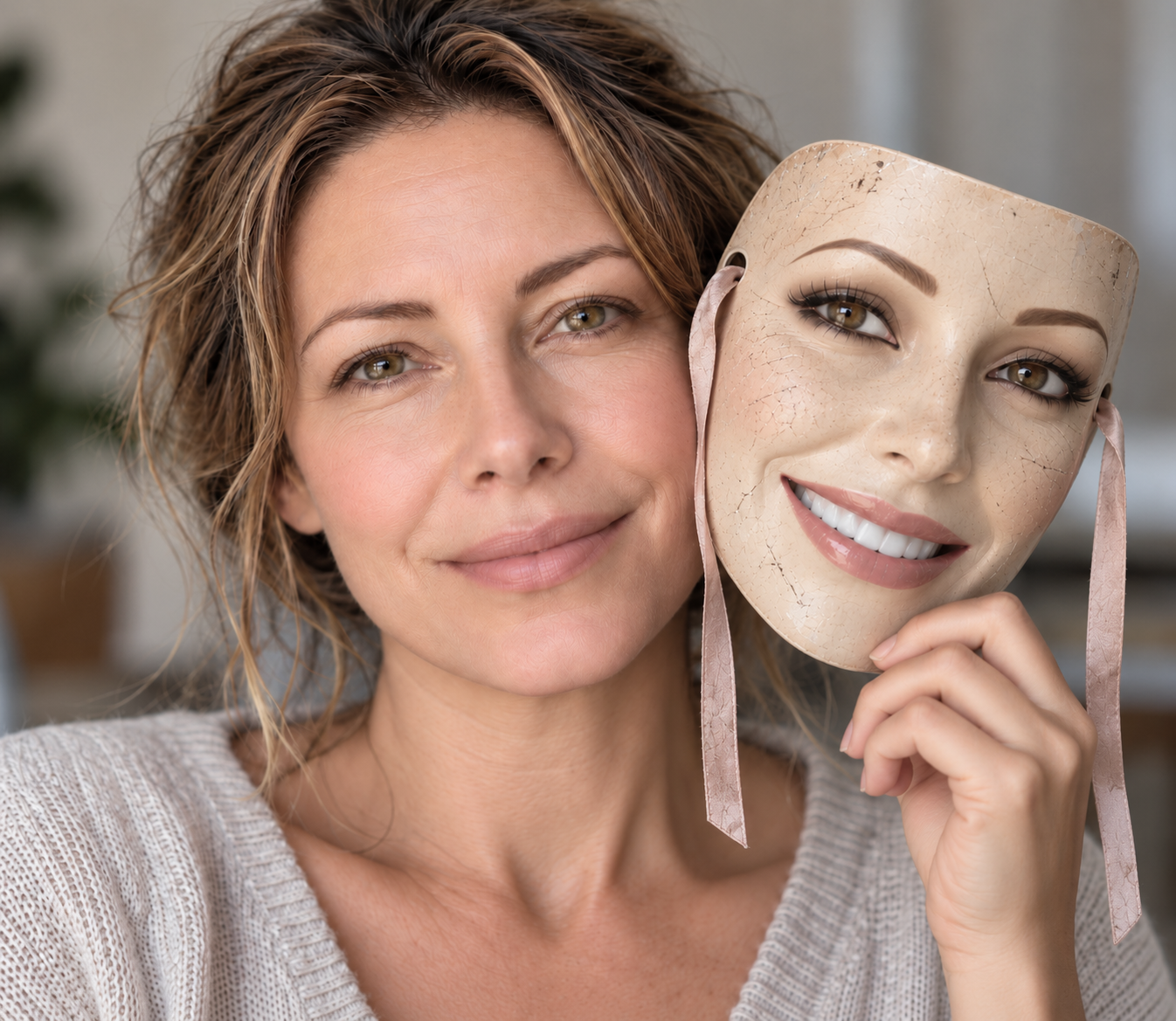
These are very real concerns. But being authentic doesn’t mean having to share every detail of our lives with everyone we encounter. We can choose what we share, when we share it, and with whom we share it. What matters most is having relationships in which we feel comfortable enough to show up as the truest version of ourselves. Relationships where we can say, “Actually, things have been a little difficult lately.”
We all deserve relationships where we can admit when we may need support. Where we can show up feeling uncertain, imperfect, and still know that we are valued.
Permission to Be Human
As we think about the masks we wear and the reasons we wear them, there’s something worth remembering: Life isn’t always easy. In fact, it rarely is. And one of the things we learn as we get older is that it was never really supposed to be.
There will always be both expected and unexpected challenges to navigate. Some seasons will be more difficult than others. There will be times when it seems we have more to navigate or our plate feels especially full. But here is the reality… If we wait for life to become perfectly manageable before allowing ourselves to feel happy or at peace, we may spend a long time waiting. Contentment doesn’t have to wait for perfection.
We can experience happiness and also be facing challenges. We can be grateful for our lives and still wish certain things were different. We can love our families and sometimes feel overwhelmed by the responsibilities that come with caring for them. We can be strong and still need someone others.
Two things can be true at once. And perhaps one of the most freeing things we can do is stop expecting ourselves to be anything other than human.
This Halloween, Consider Taking Off the Mask
If you’re reading this and recognize a little of yourself, I hope you’ll give yourself permission to remove some of the masks you’ve been wearing. The mask of perfection. The mask of always being capable. The mask of having your life together. The mask of knowing exactly what to do. Because one absolute truth is that none of us has everything figured out. We’re all carrying something. Often, we’re facing challenges that the people around us know very little about. You deserve relationships where you can be your truest self, where you don’t have to pretend that everything is wonderful and where asking for support doesn’t feel like admitting defeat.
And perhaps, most importantly, you deserve to be honest with yourself. Removing the mask doesn’t mean everything will suddenly become easier. It doesn’t mean every relationship will respond the way we hope, or that every challenge will disappear.
But it does offer something that pretending never can.
The freedom to be yourself.
Because the person behind the mask deserves to be seen, too.
………
Ready to talk? Stone Harbor Therapy provides online therapy for women throughout North Carolina and New York, with support for anxiety, relationships, grief, fertility, motherhood, and life transitions.
Contact Stone Harbor Therapy to schedule a free 15-minute consultation.
Mary Claire Kerwin, LCSW
Founder/Therapist, Stone Harbor Therapy
This article is for educational purposes and is not a substitute for individual mental health care. If you are experiencing an emergency, contact 911 or 988.